How to Build Functional Communication Skills at Home: Simple Strategies for Verbal and Nonverbal Kids

Key Points:
- To build functional communication skills in autistic children at home, start by observing how your child currently communicates.
- Set simple, useful goals like requesting or asking for help. Use consistent words, signs, or visuals during daily routines.
- For nonverbal kids, offer picture choices or gestures, and reinforce every communication attempt.
Many parents watch their child struggle to speak or point and wonder how to help. Functional communication in autism is about helping your child share what they need in ways that actually work in daily life. That can mean words, gestures, pictures, or buttons on a device. When communication gets easier, everyday routines usually feel calmer for everyone.
The sections below offer practical, step-by-step ideas you can try at home for both verbal and nonverbal kids.

Step 1: Learn to Understand Your Child’s Current Communication
Before you change anything, you need a clear picture of what your child already does. Even if it feels like “nothing,” there are usually small signals hiding in daily routines.
Start by watching how your child tries to get needs met. Look at meals, playtime, screen time, and transitions. Notice when they pull your hand, push things away, or repeat certain phrases. These are all early pieces of communication skills development, even if they are hard to read right now.
You can make a simple list for a few days:
- How your child sends messages: Words, sounds, scripts, gestures, pulling, pointing, handing you items.
- How your child shows understanding: Following directions, reacting to their name, responding to pictures or routines.
- What seems hardest: Asking for help, accepting “no,” waiting, switching activities.
This kind of observation lines up with how researchers measure receptive and expressive skills in early intervention programs and in autism with speech delay.
Recent work tracking preschool children in early services found that starting levels in receptive and expressive language helped predict later outcomes. As you watch, try not to label anything as “good” or “bad.” Treat what you see as useful clues. They will guide the goals you choose next.
Step 2: Choose the Right Communication Goals at Home
Once you see how your child currently communicates, you can set communication goals and autism plans that match real life. Good goals are specific, useful, and practiced often.
Helpful goal areas include:
- Requesting: Asking for favorite foods, toys, videos, or activities.
- Asking for help: Letting you know when something is too hard or broken.
- Taking a break: Saying “all done,” “break,” or using a break card.
- Saying no safely: Using a word, card, or gesture instead of hitting or dropping to the floor.
- Sharing interests: Pointing, showing, or commenting, “look”, or “wow.”
Choose one to three goals that would ease daily life the most. Small, clear goals make it more likely you will practice consistently.
Step 3: Support Verbal Communication in Autism
Some children already use a few words, sounds, or phrases, but struggle to use them in useful ways. Verbal communication autism support at home can help turn scattered words into practical tools.
A helpful strategy is to model short, repeatable phrases during routines. Use the same wording every time so your child hears a stable pattern. You might say “want juice,” “help me,” or “all done” in the same situations every day.
You can make this more concrete:
- Keep phrases short: Use one to three words that match what your child can copy.
- Pair words with actions: Say “open please” while opening the snack or “help me” while you guide their hands.
- Reward attempts: Give the snack or help as soon as your child tries the phrase, even if the words are not clear.
When your child already uses single words, you can gently expand them. If they say “ball,” respond with “want ball” or “roll ball.” If they use scripts from shows, sometimes called autism scripting, add a word that fits the moment, so the script slowly becomes more functional.
Research on language development in autism shows that consistent models and expansions can support the development of language skills over time. The goal is not perfect grammar. The goal is communication that helps your child get through the day with fewer tears and more connection.
Step 4: Use Non-Verbal Communication Strategies at Home
Many autistic children, including those described as nonverbal autism profiles, communicate best without speech, especially in the early years. Non-verbal communication strategies can be just as powerful as words and often come more naturally for the child.
Think about giving your child a “toolbox” of nonverbal ways to send messages. Each tool should be simple and easy to repeat across routines. These may include pointing, simple signs, picture cards, or a basic communication board.
You can build this toolbox step by step:
- Teach useful gestures: Reach for “up,” tap lips for “eat,” push away for “no,” tap chest for “me.”
- Introduce simple signs: Start with high-value words like “more,” “eat,” “drink,” “help,” or “play.”
- Offer picture choices: Present two picture cards for snacks or activities and honor the choice your child makes.
Pair nonverbal tools with spoken words whenever possible. When your child taps a picture for “snack,” you can say “snack, please” as you give it. Over time, this mix can strengthen expressive communication autism skills, whether spoken or not.
Step 5: Turn Challenging Behavior Into Communication
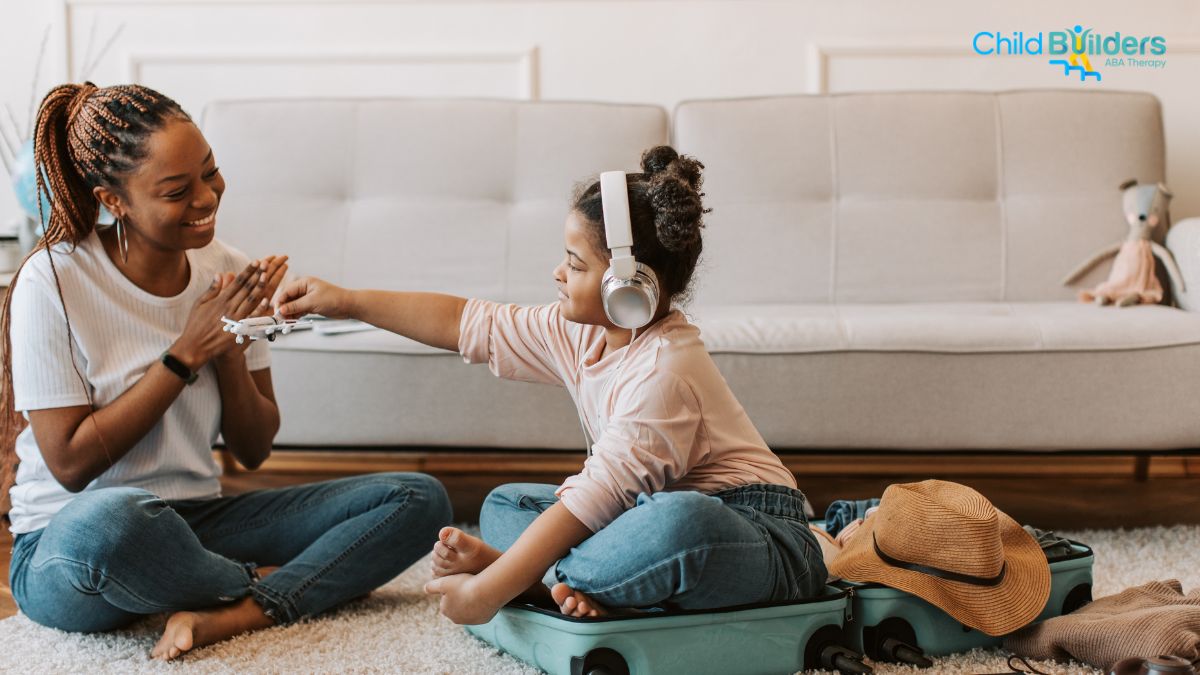
Challenging behavior often shows up where communication is weakest. Functional Communication Training (FCT) is a well-studied approach that teaches a clearer way to ask for the same thing the behavior was trying to get.
You do not have to run a full clinic program where you live. ABA therapy at home often borrows the same core ideas and applies them to daily life.
First, notice patterns. Maybe your child drops to the floor when a show ends or hits when you remove a toy. In each case, there is usually a purpose behind the behavior, such as getting more time, getting out of a task, or getting attention.
Once you guess the purpose, you can teach a different response:
- Pick a new signal: Choose a word, sign, picture, or button that means the same thing as the behavior.
- Prompt before the meltdown: Right before trouble usually starts, prompt your child to use the new signal.
- Reward the new skill: Give more time, a short break, or attention as soon as they use the signal, even with help.
A 2025 meta-analysis found that FCT produces moderate to large improvements in both challenging behavior and functional communication response across many studies. When you apply this idea at home, start small. Pick one behavior, one new signal, and one routine. As that improves, you can add another.
Step 6: Practice Skills Across Routines and Caregivers
New communication skills grow when they show up in many places, with many people. That is where communication development autism support becomes part of daily life rather than just “therapy time.”
Instead of setting aside a separate hour, many families thread practice into routines they already have, sometimes with support from ABA parent consultation. Choose a few daily moments and use the same words, signs, or pictures every time they come up.
Strong practice spots include:
- Meals and snacks: Requesting foods, drinks, “more,” and “all done.”
- Play and hobbies: Asking for favorite toys, “my turn,” or “help.”
- Screen time and games: Asking to start, asking for “one more,” or agreeing to “last one.”
- Outings and errands: Asking to go, asking for a break, or signaling when they want to leave.
When multiple adults care for your child, try to agree on a few shared phrases or pictures. Simple recording helps you see patterns over time. You can jot down which communication goals autism skills seem easier now and which still feel hard.
If you ever work with professionals, this kind of record gives them a strong starting point during the ABA assessment process.

FAQs About Functional Communication Training
How early should parents start working on communication skills for an autistic child?
Parents should start working on communication skills for an autistic child as soon as they notice differences in eye contact, gestures, or responsiveness, even before diagnosis. Early support during toddler and preschool years improves social communication and builds a strong foundation for language development.
How much time per day should we spend on communication practice?
Families should focus on short, frequent communication practices throughout the day rather than long sessions. Adding one or two teaching moments into three to five daily routines, like meals, dressing, or play, is an effective and realistic way to build communication skills in autistic children.
What if my child has stronger receptive than expressive skills?
If your child has stronger receptive than expressive skills, focus on building expressive language using signs, pictures, or short phrases. Keep directions simple and support understanding with gestures or visuals. Children with strong receptive skills often improve expressive abilities with consistent, targeted teaching.
Get Support for Home Communication Goals
Building communication at home can feel like a lot to manage, especially when behavior, emotions, and daily demands are involved. ABA therapy services in Massachusetts, Rhode Island, and New Hampshire can help families turn routines into steady practice, using strategies like modeling, non-verbal communication strategies, and FCT to make skills more usable.
At ChildBuilders, we design personalized, evidence-based programs that target the communication goals that matter most to your family and coach you through everyday use at home. We work side by side with caregivers so strategies feel realistic, not overwhelming, and so children experience the same support from one day to the next.
If you are ready to build more reliable ways for your child to ask, refuse, share, and connect, reach out to our team to learn how we can partner with you on the next steps.
























.jpg)